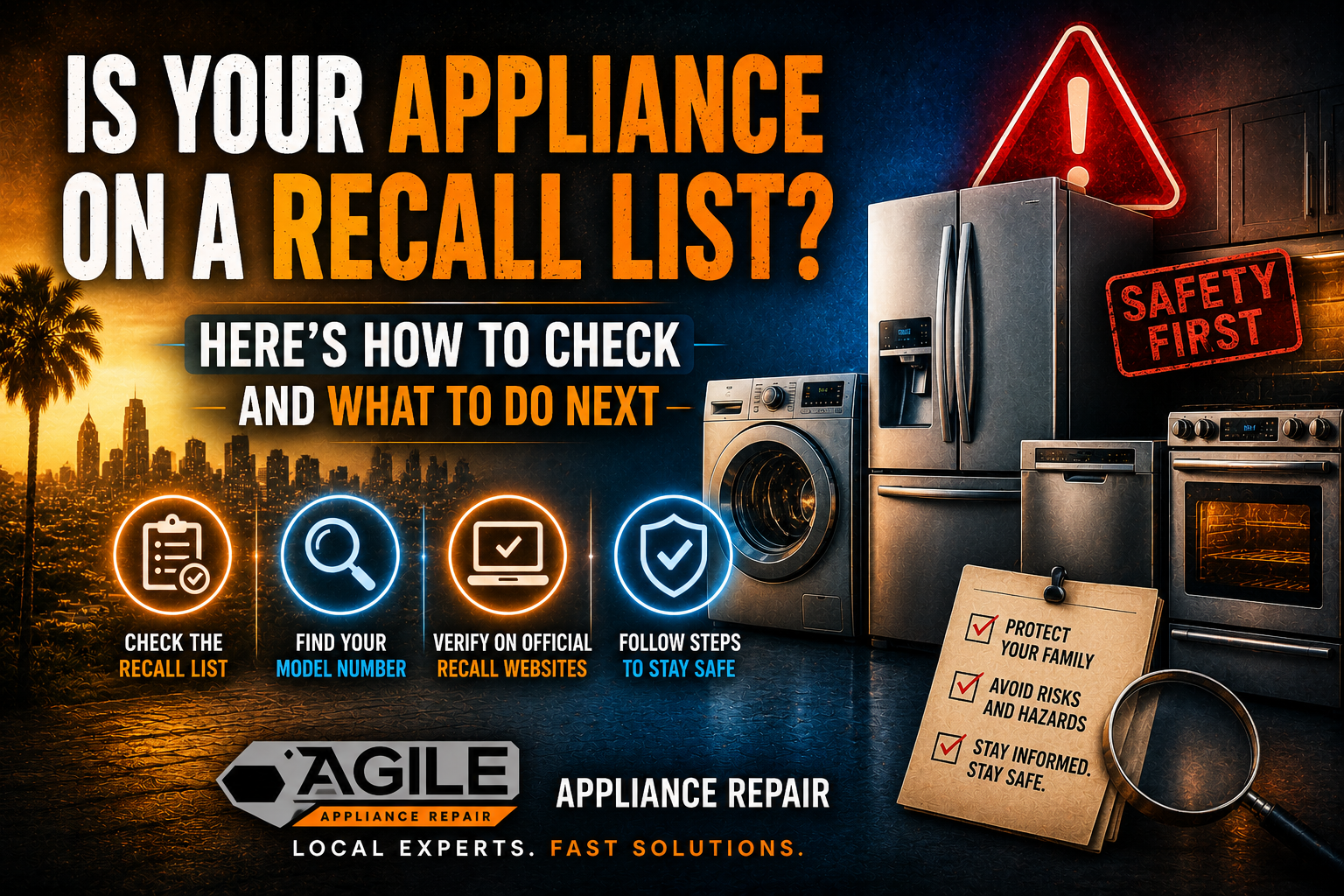
Your dishwasher, dryer, or refrigerator might be sitting in your home right now with a known safety defect — and you’d have no idea.
Appliance recalls happen more often than most people realize. Manufacturers issue them when a product is found to pose a fire hazard, electrical risk, or other danger to consumers. The problem is that only a fraction of recalled products are ever actually returned or repaired. Many continue to be used in homes for years after a recall is issued, simply because the owners never found out.
The U.S. Consumer Product Safety Commission (CPSC) issues hundreds of product recalls every year, and home appliances are consistently among the most common categories. In recent years alone, major recalls have been issued for dishwashers linked to house fires, refrigerators with faulty ice maker components, dryers with overheating hazards, and ranges with gas leak risks.
This guide will show you exactly how to check whether any appliance in your home is under recall, what to do if it is, and why you should never ignore a recall notice — no matter how minor it sounds.
Why Appliance Recalls Are a Bigger Deal Than People Realize
It’s easy to dismiss a recall as a corporate formality — until you understand what actually triggers one. A recall is not issued because a product might be mildly inconvenient. It’s issued because there is a documented safety risk, often backed by reports of injuries, fires, or property damage already occurring.
Here’s what makes appliance recalls particularly serious:
• Appliances operate unattended. Your dishwasher runs while you sleep. Your dryer runs while you’re in another room. A defect that causes overheating or sparking in an unattended appliance can become a house fire before anyone notices.
• Many recalls involve fire hazards specifically. A significant portion of appliance recalls are tied to overheating components, faulty wiring, or electrical failures that can ignite surrounding materials.
• Recalls can affect appliances you’ve owned for years. A recall can be issued for a product that’s been on the market — and in your home — for several years. Age does not mean safety.
• Using a recalled appliance may affect your insurance coverage. If a recalled appliance causes damage and you were aware of (or should have been aware of) the recall, your homeowner’s insurance claim could be complicated.
How to Check If Your Appliance Has Been Recalled
Checking for a recall takes about 5 minutes per appliance. You’ll need the brand name, model number, and ideally the serial number. These are typically found on a label inside the door frame, on the back panel, or on the underside of the appliance.
1. CPSC.gov — The Official U.S. Recall Database
The Consumer Product Safety Commission maintains the most comprehensive and authoritative recall database in the country. Every federally mandated recall is listed here.
• Go to www.cpsc.gov/recalls
• Use the search bar to search by brand name, product type, or keyword
• Filter by “Appliances” under product category to narrow results
• Match your model number against the recall listing — the recall notice will specify exactly which model numbers are affected
2. Recall.gov — The Government’s Multi-Agency Recall Hub
Recall.gov aggregates recall information from multiple federal agencies, including the CPSC, FDA, USDA, and NHTSA. While most home appliance recalls fall under the CPSC, this site gives you one place to search across all government recall databases. It’s especially useful if you’re unsure which agency oversees your specific product.
3. The Manufacturer’s Website
Most major appliance brands maintain a safety or recall section on their website where they list all current and past recalls. This is often the fastest way to check a specific brand.
Direct recall pages for major brands:
• GE Appliances: geappliances.com/ge/about-ge-appliances/product-safety.htm
• Samsung: samsung.com/us/support/product-safety/
• LG: lg.com/us/support/product-help/CT10000010-20150264498005
• Whirlpool (also covers Maytag, KitchenAid, Amana): whirlpool.com/product-safety-notices.html
• Bosch: bosch-home.com/us/service/product-recall
4. Sign Up for Recall Alerts
Rather than checking manually, you can subscribe to receive recall alerts automatically. The CPSC offers a free email and text notification service at cpsc.gov/recalls — you can sign up to receive alerts for specific product categories, including appliances. This means you’ll be notified as soon as a new recall is issued, without having to remember to check.
5. Register Your Appliances at Purchase
This is the single most effective way to be notified of a recall: register your appliance with the manufacturer when you buy it. Manufacturers are legally required to contact registered owners when a recall is issued. The registration card in the box — or the online registration form on the brand’s website — takes less than 2 minutes to complete. Yet most homeowners skip this step entirely. If you have appliances that were never registered, it’s not too late — you can register them retroactively on the manufacturer’s website using your model and serial number.
Which Appliances Are Most Commonly Recalled?
While any appliance can be subject to a recall, certain categories come up more frequently:
• Dishwashers: Frequently recalled for fire hazards related to faulty wiring in the control panel or overheating pump motors. Dishwashers that run unattended overnight are especially concerning when a defect is involved.
• Dryers: Recalled for overheating, ignition of lint buildup, and faulty heating elements. A combination of a recalled dryer and a clogged dryer vent is a serious fire risk.
• Refrigerators: Recalled for ice maker electrical faults, compressor overheating, and door hinge failures. Some refrigerator recalls have involved fire hazards in the control board or wiring harness.
• Ranges & Ovens: Recalled for gas valve defects, oven door glass shattering, and control knob issues that can cause unintended ignition.
• Microwaves: Recalled for sparking, arcing, and fire hazards related to faulty magnetron components.
• Washing machines: Recalled for overheating motors, excessive vibration that can cause falls, and lid/door latch failures.
What to Do If Your Appliance Is Under Recall
Finding out your appliance has been recalled can feel alarming, but the process for resolving it is usually straightforward. Here’s what to do:
• Stop using it immediately if the recall notice recommends doing so. Don’t use your judgment about whether the risk applies to your specific unit — follow the manufacturer’s guidance exactly.
• Contact the manufacturer. The recall notice will include specific instructions and a contact number. Manufacturers are typically required to offer one of the following remedies at no cost to you: a free repair, a replacement unit, or a full refund.
• Document everything. Keep records of your communications with the manufacturer, including dates and any reference numbers provided. This is important if any damage or injury has already occurred.
• Don’t sell or give away a recalled appliance. Passing on a recalled product to someone else — even through a garage sale or online listing — is both dangerous and potentially illegal.
• If damage has already occurred, contact your homeowner’s insurance provider and document the connection between the recalled product and the damage. You may have a claim against the manufacturer.
What Happens If You Ignore a Recall?
Ignoring a recall is not just risky — it can have real financial and legal consequences:
• The defect that triggered the recall does not go away on its own. The underlying risk remains present every time the appliance is used.
• If the appliance causes a fire or injury and you were aware of the recall, your homeowner’s insurance may reduce or deny coverage for the resulting claim.
• Recalls are time-sensitive. Manufacturers are only required to offer free remedies for a defined period. Once that window closes, you may no longer be eligible for a free repair or replacement.
A Note for San Jose Homeowners
Bay Area homes often hold onto appliances longer than the national average, thanks in part to the high cost of replacement. This means there’s a higher likelihood that an older appliance in a San Jose home may have an outstanding recall that was never acted upon.
If you’ve recently moved into a home, inherited appliances from a previous owner, or purchased used appliances, checking for recalls is especially important. Recall status does not transfer automatically with ownership — it’s your responsibility as the current user to check and act on any outstanding notices.
When to Call a Professional
If a recall requires a repair rather than a full replacement, the manufacturer will typically arrange for a certified technician to perform the fix at no cost. However, if you’ve discovered a recall on an older appliance and the manufacturer’s remedy period has expired, or if you want an independent assessment of whether the recalled component poses an ongoing risk, a qualified appliance technician can inspect the unit and advise you.
At Agile Appliance Repair, we’re familiar with common recall-related issues across all major appliance brands. If you’re unsure about the safety of an appliance in your home — recalled or not — we’re happy to take a look.
⚠️ Not sure if your appliances are safe?
Our certified technicians can inspect your appliances and flag any safety concerns — recalled components included. Book a visit with Agile Appliance Repair today.
Call us at (650) 625-7475 or Book Online Here