Your refrigerator stops cooling. You call for a repair. The technician tells you the manufacturer won’t release the diagnostic software to anyone but their own authorized dealers — the nearest one is booked three weeks out, and their labor rate is double what an independent shop would charge.
This used to be perfectly legal. As of July 1, 2024, it isn’t anymore.
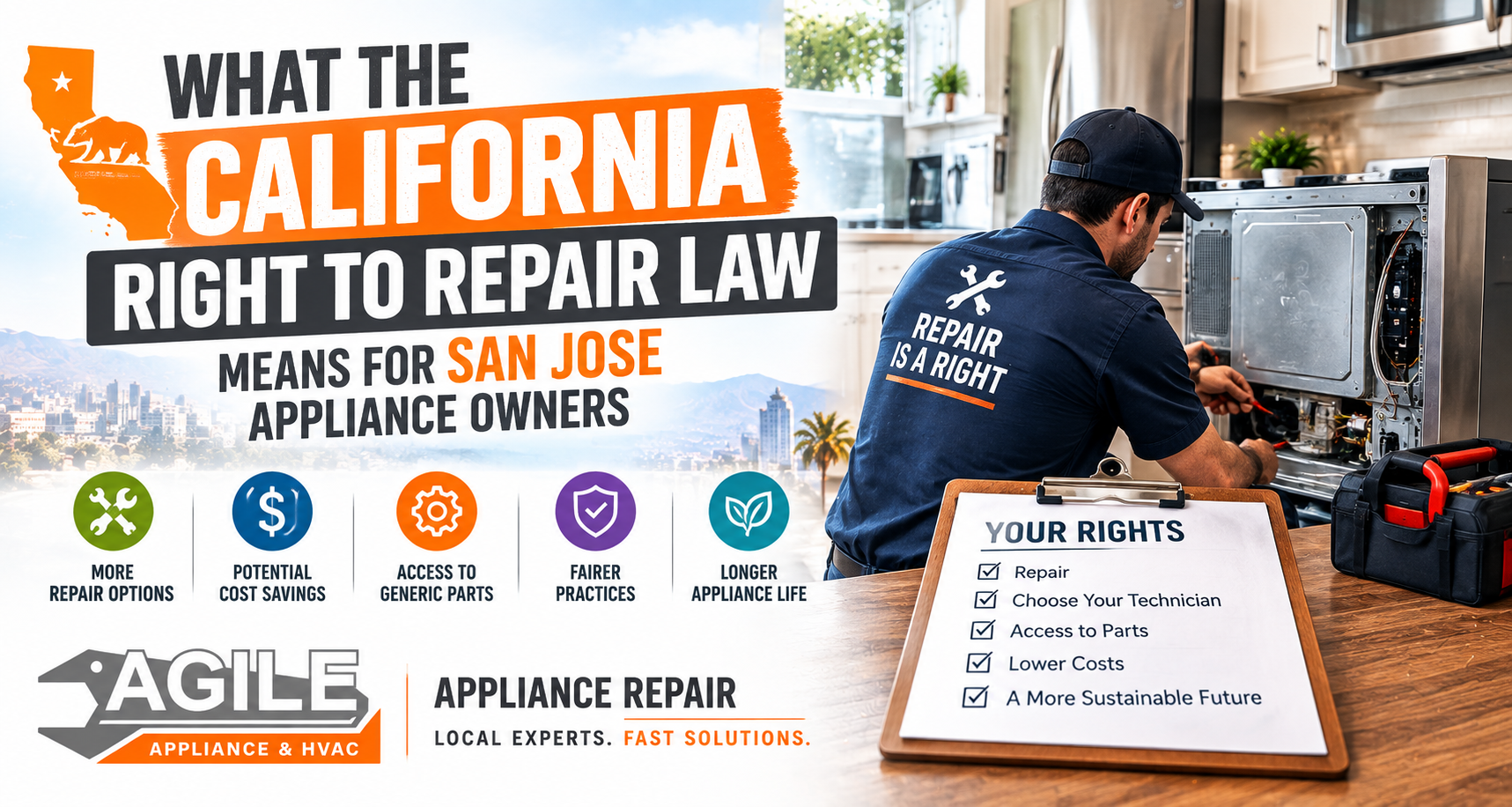
California’s Right to Repair Act (SB 244) is one of the most significant consumer protection laws passed in the state in years — and most San Jose homeowners have no idea it exists. This guide breaks down exactly what the law does, which appliances it covers, what you’re now entitled to as a homeowner, and how to use these rights when a manufacturer pushes back.
What Is California’s Right to Repair Law (SB 244)?
SB 244, signed into law in October 2023 and effective July 1, 2024, requires manufacturers of electronics and home appliances to make repair parts, service documentation, and diagnostic tools available to both consumers and independent repair shops — not just their own authorized dealers.
Before this law, manufacturers could legally lock repairs behind exclusive dealer networks, withhold service manuals, and refuse to sell replacement parts to anyone outside their authorized network. That gave them enormous pricing power and effectively forced consumers into either paying inflated authorized repair rates or replacing appliances entirely.
SB 244 breaks that monopoly open.
According to CALPIRG, California consumers could save more than $5 billion through repairing rather than replacing electronics and appliances — savings made possible precisely because independent repair shops can now compete on a level playing field.
Which Appliances Are Covered?
The law applies to electronics and home appliance products first sold or manufactured in California on or after July 1, 2021 with a wholesale price of $50 or more. That covers nearly every major home appliance you own.
Covered appliances include:
- Refrigerators and freezers
- Washers and dryers
- Dishwashers
- Ovens and ranges
- Televisions and home audio equipment
- Laptops, tablets, and smartphones
- Air conditioners and other residential HVAC components
- Microwaves
Not covered under SB 244:
- Video game consoles
- Alarm systems regulated under the Alarm Companies Act
- Agricultural, construction, or industrial equipment
- Any product with a wholesale price under $50
What about appliances bought before July 2021? The law applies to products first sold or used in California on or after July 1, 2021. If you purchased a refrigerator in 2022, for example, it is covered regardless of when SB 244 took effect. The key date is when the product entered California commerce, not when you personally bought it.
What Manufacturers Are Now Required to Provide
This is the core of the law — and the part that directly affects how easily and affordably you can get your appliances repaired.
Under SB 244, manufacturers must make three categories of resources available on “fair and reasonable terms” — defined as costs and conditions equal to the most favorable terms they offer their own authorized service providers:
1. Replacement Parts
Manufacturers must supply the same parts to independent repair shops and individual consumers that they supply to their authorized dealer networks. They cannot refuse to sell parts, charge significantly higher prices, or create artificial delays for independent repair providers.
2. Service Documentation
Service manuals, diagnostic procedures, wiring diagrams, assembly instructions, technical bulletins — all of this must be made available. Before SB 244, many manufacturers locked this documentation behind login walls that only authorized dealers could access.
3. Diagnostic Tools and Software
This is the most impactful provision for modern appliances. Smart appliances — refrigerators with connected displays, washers with error code systems, HVAC units with digital controls — often require manufacturer software to diagnose fault codes, calibrate sensors, or complete a repair. Manufacturers must now provide access to these tools at fair prices. Most digital documentation must be provided at no charge.
How Long Does This Protection Last?
The law creates different protection windows based on the product’s wholesale price:
| Wholesale Price | Duration of Manufacturer Obligation |
|---|---|
| $50 – $99.99 | 3 years after the last date of manufacture |
| $100 or more | 7 years after the last date of manufacture |
Since virtually every major home appliance costs well over $100 wholesale, you can expect a 7-year window of protected repair access for your refrigerator, washer, dryer, dishwasher, and HVAC components. That means if your appliance was manufactured in 2022, manufacturers are legally obligated to support its repair until at least 2029.
What This Means Practically for San Jose Homeowners
✅ More Choice in Who Repairs Your Appliances
Before SB 244, some manufacturers would void warranties or refuse parts to independent shops. That artificially channeled repair work to authorized dealers with higher labor rates, longer wait times, and limited local availability. Now, your trusted local repair company has the same legal access to parts and documentation as a Samsung-certified dealer.
Real example: A Samsung refrigerator with a faulty control board previously required Samsung-authorized service, where diagnostic fees alone could run $150–$200 before any parts were ordered. Under SB 244, an independent appliance repair shop can now legally access the same diagnostic software, order the same part at comparable pricing, and complete the repair — often faster and for less.
✅ More Competitive Repair Pricing
When one provider has a monopoly on parts and information, they set the price. Competition drives costs down. The U.S. PIRG Education Fund estimated that independent repair businesses often charge 20–30% less than manufacturer-authorized shops for the same repairs, precisely because their overhead isn’t tied to exclusive licensing fees.
✅ Repair Over Replace Becomes a Real Option
One of the most common frustrations homeowners face is being told an appliance “can’t be repaired” — not because it genuinely can’t, but because the technician doesn’t have access to the parts or documentation needed to fix it. SB 244 removes that barrier.
Real example: A San Jose homeowner has a 4-year-old LG washer throwing an error code. Previously, a technician without LG authorization couldn’t run a proper diagnostic and would recommend replacement. Under SB 244, that same technician can access LG’s diagnostic software, identify a failed motor sensor ($45 part), and complete the repair for a fraction of the cost of a new machine.
✅ Your Warranty Cannot Be Voided for Using Independent Repair
This is one of the most misunderstood points in appliance ownership. Federal law — the Magnuson-Moss Warranty Act — already prohibited manufacturers from voiding warranties solely because you used a third-party repair service. SB 244 reinforces this protection in California, and manufacturers now have less legal standing than ever to make that threat stick.
If a manufacturer tells you your warranty is void because you used an independent repair shop, that claim has no legal basis under either federal or California state law — as long as the repair was done competently and with appropriate parts.
What Manufacturers Are Doing in Response
Major appliance brands have responded to SB 244 at varying speeds and with varying degrees of cooperation:
- Samsung has broadened its self-repair portal to include appliance categories, making more parts and documentation publicly accessible.
- LG has made diagnostic software available through partner portals, though some independent shops report ongoing annual licensing fees that authorized dealers receive free — a practice that may conflict with SB 244’s “fair and reasonable terms” standard.
- Whirlpool brands (which also includes Maytag, KitchenAid, and JennAir) opened factory service manuals that were previously locked behind login walls.
However, compliance is uneven. Some premium European brands and smaller manufacturers continue to restrict access in ways that independent repair advocates argue violate the law. The penalties for non-compliance escalate quickly — $1,000 per day for a first violation, rising to $5,000 per day for repeat violations — creating real financial consequences for manufacturers who ignore their obligations.
What to Do If a Manufacturer Won’t Cooperate
SB 244 gives you rights on paper. Here’s how to enforce them in practice.
Step 1: Check the manufacturer’s website directly Most major brands now have repair portals. Search for “[Brand name] self-repair” or “[Brand name] service documentation.”
Step 2: Contact customer service and cite SB 244 specifically Many frontline representatives aren’t aware of the law. Saying “I’m requesting parts and documentation under California SB 244, the Right to Repair Act” often escalates the conversation quickly.
Step 3: Document everything Screenshot chat transcripts, save email threads, and take notes on phone calls — including the date, the representative’s name, and exactly what was requested and refused.
Step 4: File a complaint with the California Attorney General Visit the California AG’s consumer complaint page and submit the documented refusal. Include the product make, model, date of purchase, what materials were requested, and the denial.
Step 5: Report to the FTC The Federal Trade Commission’s complaint portal collects data that helps identify systemic violations, even if they don’t resolve individual cases.
How Agile Appliance Repair Uses SB 244 to Serve San Jose Homeowners Better
At Agile Appliance Repair, SB 244 directly improves what we can do for you. We now have legal access to manufacturer documentation, diagnostic tools, and parts that were previously unavailable to independent shops — which means we can diagnose more accurately, repair a wider range of appliance models, and complete jobs faster without routing you through slow authorized dealer channels.
If you’ve been told an appliance “can’t be repaired” or received a quote that seemed unreasonably high from an authorized dealer, it’s worth calling us. The landscape has changed.
You may also find these related guides helpful:
- The Most Expensive Appliance Repairs — And How to Avoid Them
- How Long Should Appliances Last? When to Repair vs. Replace
- California Appliance Rebates in 2026: How San Jose Homeowners Can Save Hundreds
- Hidden Appliance Problems That Can Become Fire Hazards
Book a Service Appointment
Have an appliance that needs diagnosing or repairing? We serve San Jose and the surrounding South Bay with honest assessments and upfront pricing.
📞 Call us at (650) 625-7475 or Book a Service Appointment — we’ll tell you exactly what’s wrong and what it costs before we touch anything.
Frequently Asked Questions
The law covers products first sold or used in California on or after July 1, 2021. If your appliance was new in 2021 or later, it is covered — regardless of when the law took effect. Appliances purchased before July 2021 fall under the older Civil Code Section 1793.03, which has more limited protections.
Yes, for residential HVAC components that qualify under the wholesale price threshold ($50+). Smart thermostats, control boards, and diagnostic tools for HVAC systems are covered. Commercial or industrial HVAC equipment is excluded.
Yes. SB 244 extends rights to both consumers and independent repair shops. If you want to attempt a DIY repair, you are entitled to the same parts, documentation, and diagnostic tools that an authorized dealer receives — at fair prices. That said, DIY repairs on gas or electrical appliances carry safety risks, and we’d recommend professional service for anything involving gas lines, refrigerant, or high-voltage components.
No. Under the federal Magnuson-Moss Warranty Act, manufacturers cannot void your warranty solely because you used a third-party repair service. California’s SB 244 reinforces this protection. The only scenario where warranty issues could arise is if the repair was done improperly and caused additional damage — which is why choosing a qualified, experienced independent repair company matters.
Document the refusal and file a complaint with the California Attorney General and the FTC. Non-compliant manufacturers face penalties starting at $1,000 per day per violation. Consumer complaints are what trigger enforcement action.
Yes — this is one of the most important aspects of SB 244. Manufacturers must provide software tools needed for provisioning, programming, pairing, and calibration after repairs. If a manufacturer uses software locks to prevent a repaired appliance from functioning correctly, that’s a violation of the law.