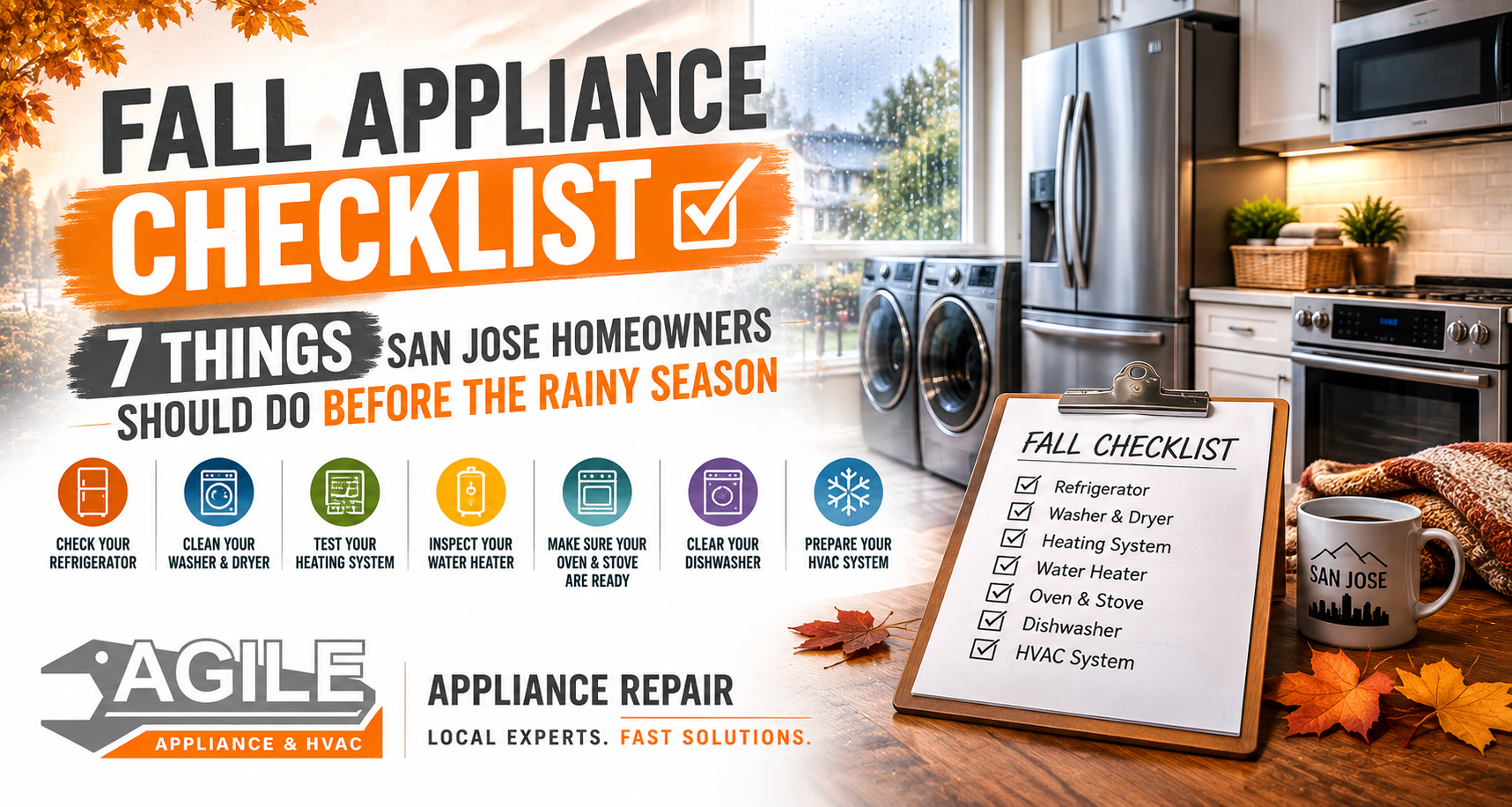
Most San Jose homeowners think about fall maintenance in terms of their roof and gutters. Appliances? Almost never. But your home’s appliances take a real beating once the rainy season kicks in — and the ones that fail in November almost always started showing signs in September and October.
San Jose’s rainy season officially begins around November 4 and runs all the way to mid-May, with November averaging 2.3 inches of rain and December jumping to 3.4 inches. That shift in weather brings power fluctuations, increased humidity, heavier dryer loads, and an HVAC system suddenly working overtime after months of sitting idle.
This checklist covers the 7 most important appliance tasks San Jose homeowners should complete before the first storms roll in — and what happens when you skip them.
Why Fall Is the Right Time (Not Winter)
Here’s the mistake most homeowners make: they wait until something breaks to deal with it. By then it’s raining, every repair company is slammed, and you’re waiting days for a technician — without heat, without hot water, or with a dryer that smells like burning lint.
The window between September and late October is ideal. Weather is still mild, repair slots are more available, and a small preventive fix now costs a fraction of what an emergency call costs in January.
With that in mind, here’s your checklist.
✅ #1: Get Your Furnace or Heating System Inspected
This is the most critical item on the list, and the one most people put off.
Your furnace likely hasn’t run since March or April. Dust, debris, and sometimes even small pests can settle inside during the off-season. When you fire it up for the first time on a cold November night, you’re asking a system that’s been dormant for six months to run flawlessly — without ever checking if it will.
What to do:
- Replace your furnace filter (do this now even if you don’t schedule a full tune-up)
- Check that all vents throughout the house are open and unobstructed
- Listen for unusual sounds the first time you run the heat — banging, rattling, or squealing are all red flags
- Schedule a professional HVAC inspection if the unit is over 5 years old or hasn’t been serviced in 12+ months
Real example: A San Jose homeowner on Willow Glen Avenue skips their annual furnace tune-up two years in a row. On the first cold night in November, the heat exchanger cracks — a $1,200+ repair that could have been caught for $89 during a routine inspection.
We covered HVAC prep in detail in our post on Is Your HVAC System Winter-Ready? Here’s Why You Should Check Now. It’s worth a read before you call.
✅ #2: Clean Your Dryer Vent — This Is a Fire Safety Issue
Fall means heavier laundry. Jeans, hoodies, towels, blankets — all items that shed more lint than summer clothes and take longer to dry. That increased load, combined with a vent that hasn’t been cleaned since spring, is exactly how dryer fires start.
According to LintSnap’s dryer fire safety data, approximately 2,900 residential dryer fires occur every year in the U.S., causing 5 deaths, 100 injuries, and $35 million in property damage. The single leading preventable cause? Failure to clean — responsible for 34% of all dryer fires.
Lint has an ignition temperature of around 400–450°F. Your dryer operates between 125–135°F normally — but a clogged vent traps heat and can push temperatures well past safe levels.
What to do:
- Pull the dryer away from the wall and disconnect the vent hose
- Clear lint from the hose, the wall duct opening, and the exterior vent cap
- Check that the exterior vent flap opens freely when the dryer runs (a stuck flap is a common blockage point)
- If the vent run is long or goes through walls, hire a professional vent cleaning service — DIY kits can’t reach deep clogs
How often: Once a year at minimum. Twice a year for households with pets, large families, or frequent dryer use.
We also wrote about hidden appliance fire hazards that go beyond the dryer — check out Hidden Appliance Problems That Can Become Fire Hazards for the full picture.
✅ #3: Protect Your Appliances From Power Surges
San Jose’s rainy season brings atmospheric rivers and winter storms — and with them, the power grid fluctuations that quietly destroy appliances from the inside out.
Most people think of power surges as rare, dramatic events. They’re not. Every time a transformer gets hit by a storm, a tree falls on a line, or PG&E switches circuits during load management, a surge travels through your home’s wiring. A modern refrigerator, washer, or smart appliance with a circuit board can be damaged — or destroyed — by a surge it never visibly reacted to.
PG&E’s own grid in the Bay Area is under increasing pressure from storm activity, and the California Office of Emergency Services specifically warns homeowners to prepare appliances before storm season begins.
What to do:
- Install a whole-home surge protector at your electrical panel (costs $200–$400 installed by an electrician — far less than replacing a refrigerator or HVAC control board)
- Use UL 1449-rated point-of-use surge protectors for TVs, computers, and smart appliances
- Unplug non-essential electronics when a major storm is forecast
- If you’re on a PG&E circuit in a High Fire Threat District (Tier 2 or 3), consider a battery backup for critical appliances during PSPS outages
We covered this in depth in our post on How Winter Rain and Power Surges in San Jose Can Damage Your Appliances — essential reading before October.
✅ #4: Clean Your Refrigerator Coils
This one takes about 15 minutes and most homeowners have never done it. Dirty condenser coils are one of the most common causes of refrigerator inefficiency and premature failure — and fall is the ideal time to address it before the holiday season when your fridge works harder than ever.
The condenser coils (located either at the back or underneath your refrigerator) release heat to keep the interior cold. When they’re coated in dust, pet hair, and debris, the compressor has to work significantly harder to maintain temperature.
According to HomeAlliance’s appliance maintenance research, dirty coils can increase energy usage by up to 35% — which on a PG&E bill in San Jose translates to real money every month.
What to do:
- Unplug the refrigerator or pull it slightly away from the wall
- Use a coil cleaning brush (available at any hardware store for ~$10) and a vacuum to remove dust buildup from the coils
- While you’re back there, check that the refrigerator has at least 1–2 inches of clearance on all sides for airflow
- If the compressor sounds louder than usual or the fridge feels warm on the sides, call a technician — the coils may not be the only issue
How often: Twice a year. Pets in the home = every 3 months.
✅ #5: Check Your Water Heater Before Cold Showers Become an Emergency
Nothing makes a cold, rainy November morning worse than a water heater that’s given up. And water heaters — like furnaces — tend to fail right at the start of the season when demand spikes.
Fall is the perfect time to do a quick health check on your unit, especially if it’s 8+ years old or hasn’t been serviced in over a year.
What to check:
- Listen for rumbling or popping sounds — this points to sediment buildup, especially common in San Jose’s hard-water environment. A professional flush can extend your heater’s life by years
- Check around the base for moisture or rust — early signs of tank corrosion that will eventually become a leak
- Test the pressure relief valve — lift the lever briefly to confirm it releases and reseats properly. A stuck or leaking T&P valve is a safety concern
- Note your water temperature — if hot water runs out faster than it used to, your heating element or thermostat may need attention
We covered every water heater warning sign in detail in our post Water Heater Making Noise or Running Out of Hot Water? Here’s Why — bookmark it before you do this check.
The U.S. Department of Energy recommends an annual tank flush for homes in hard-water areas like San Jose to prevent sediment buildup and maintain efficiency.
✅ #6: Deep Clean Your Oven Before Holiday Cooking Season
This one overlaps with fire safety and energy efficiency — and it’s especially relevant heading into the November-through-January cooking marathon.
Grease and food debris baked onto oven walls and the bottom of the oven can smoke, cause odors, and in severe cases catch fire during high-temperature cooking. The NFPA reports that cooking equipment is the leading cause of home fires in the U.S., and failure to keep equipment clean is a primary contributing factor.
Beyond safety, a dirty oven runs less efficiently. Built-up residue on the oven floor acts as insulation that interferes with accurate temperature distribution — meaning your food cooks unevenly and your energy bill creeps up.
What to do:
- Run the self-clean cycle if your oven has one (open a window — it produces smoke and odors)
- For manual cleaning, remove racks and soak in warm soapy water while you clean the interior with a non-abrasive oven cleaner
- Check the oven door seal (gasket) — if it’s cracked, torn, or not sitting flush, heat escapes and your oven has to work harder. A replacement gasket costs $15–$40
- If your oven isn’t reaching the set temperature accurately, a faulty temperature sensor or igniter may need professional attention
Need more detail on oven-specific issues? Our post on Common Oven & Range Problems San Jose Homeowners Face covers the most common failures and when to call a pro.
✅ #7: Inspect Your Washing Machine Hoses and Connections
This is the most overlooked item on every fall checklist — and potentially the most damaging when it fails.
Washing machine hoses (especially rubber braided hoses that are more than 5 years old) can crack, bulge, or burst without warning. A burst washing machine hose can release 500–600 gallons of water per hour into your home, according to the Insurance Institute for Business & Home Safety (IBHS). Water damage from appliance hose failures is one of the leading causes of homeowner insurance claims in California.
Rainy season is actually when these failures spike — fluctuating temperatures cause rubber hoses to expand and contract, accelerating wear. Inspecting them before the rains arrive is simple, fast, and free.
What to do:
- Pull the washer slightly away from the wall and examine both hoses (hot and cold supply lines) for bulging, cracking, corrosion at the fittings, or any moisture
- If your hoses are rubber and over 5 years old, replace them now — stainless steel braided hoses cost $15–$25 per pair and last much longer
- Check that the drain hose is securely positioned and not kinked
- While you’re there, confirm the washer’s feet are level — an unlevel machine vibrates more, wearing out drum bearings faster
We covered summer washing machine care earlier this year, but the fall version is all about prevention before the wet months arrive.
The Real Cost of Skipping This Checklist
To put it plainly: a $0 fall maintenance routine can easily turn into a $1,500–$3,000 emergency repair or replacement call in January. Here’s how that math works:
| Skipped Task | Likely Outcome | Estimated Cost |
|---|---|---|
| Furnace inspection | Heat exchanger crack, full replacement | $1,500–$4,000 |
| Dryer vent cleaning | Dryer fire or motor failure | $500–$1,200+ |
| Surge protection | Refrigerator or HVAC control board failure | $600–$1,500 |
| Fridge coil cleaning | Compressor failure | $600–$1,200+ |
| Water heater check | Tank failure, emergency replacement | $1,000–$2,000 |
| Washing machine hose check | Burst hose, water damage | $3,000–$10,000+ |
The cost of doing all seven tasks on this list — including a professional furnace tune-up and water heater flush — is typically $300–$500. The cost of doing none of them and hoping for the best? As the table above shows, the risk exposure is significantly higher.
Let Agile Appliance Repair Help You Get Ready
At Agile Appliance Repair, we help San Jose homeowners get ahead of the season before it turns into an emergency. Whether it’s a furnace inspection, water heater flush, dryer vent check, or anything else on this list, we work across the full South Bay — and we give you honest assessments, not unnecessary upsells.
📞 Call us at (650) 625-7475 or Book a Service Appointment — before the rains arrive and everyone else is calling too.
Frequently Asked Questions
September and October are the sweet spot. San Jose’s rainy season typically starts around the first week of November, so completing these tasks in early-to-mid October gives you time to book a professional if something needs attention without rushing.
Items 4 (fridge coils), 6 (oven cleaning), and 7 (hose inspection) are straightforward DIY tasks. Items 1 (furnace), 2 (dryer vent cleaning if the run is long), 3 (whole-home surge protector installation), and 5 (water heater T&P valve and flush) benefit from or require a professional — especially if you have gas appliances.
Yes — most appliance failures don’t announce themselves in advance. Sediment in a water heater, a clogged dryer vent, and a cracked heat exchanger all develop quietly before they fail dramatically. “Seems fine” is exactly what homeowners say before an emergency call.
A furnace tune-up typically runs $80–$150. A water heater flush is $100–$200. A professional dryer vent cleaning is $100–$175. Investing in all three — roughly $300–$500 — is significantly less than any single emergency repair on the list above.
Don’t ignore it and hope it holds through winter — it usually won’t. Call a technician while repair slots are still available. October is significantly less busy than November and December for appliance repair companies in the Bay Area.