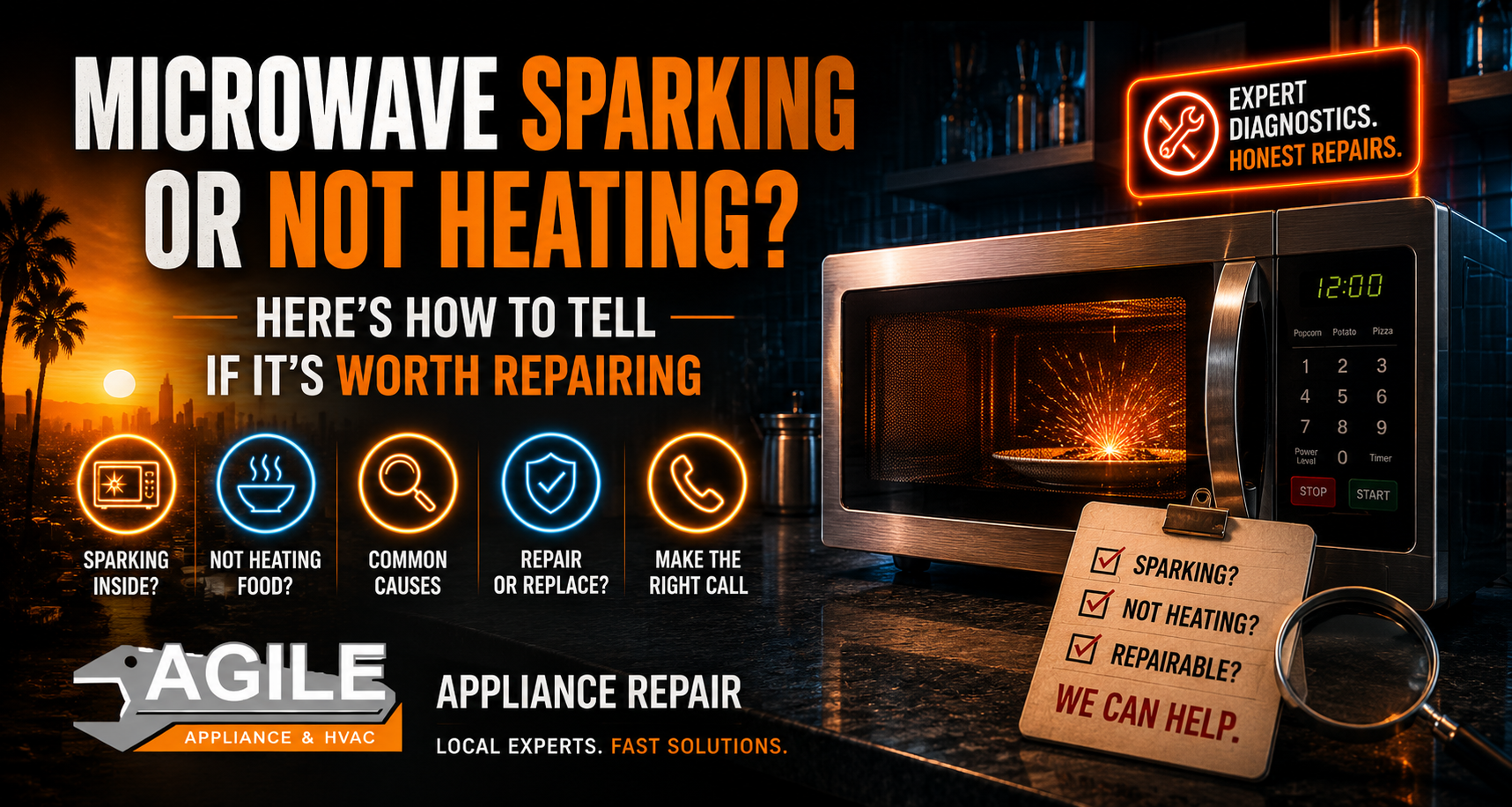
You hit start, walk away for thirty seconds, and come back to blue flashes bouncing around inside your microwave — or worse, your food is stone cold after a full cook cycle. Either way, your first question is the same: do I call a repair tech, or do I haul this thing to the curb?
The honest answer depends on what’s actually broken, how old your microwave is, and what the fix will cost compared to a new unit. Below, we break down the real causes behind sparking and no-heat microwaves, what’s actually dangerous versus what’s just annoying, and a clear framework for the repair-or-replace decision — backed by real repair cost data and fire safety research, not guesswork.
Why Is My Microwave Sparking?
Sparking (also called arcing) happens when the electromagnetic waves inside the microwave cavity hit something they shouldn’t — usually metal, carbonized food residue, or a damaged internal component. Here are the most common causes, starting with the easiest to fix.
1. Metal Inside the Cavity
This is by far the most common culprit. Aluminum foil, twist ties, metal-rimmed dishware, and even the metallic paint on some “decorative” mugs can conduct the microwave’s electromagnetic field and throw sparks. If you see sparking and there’s any metal in the cavity, stop the microwave immediately and remove it once the unit has cooled.
2. Food Debris and Grease Buildup
Splatter and food particles left on the cavity walls, ceiling, or turntable support don’t just look bad — over repeated heating cycles they become carbonized, which makes them conductive. That buildup can spark just like a stray piece of foil would. A DIY Repair Clinic guide and several appliance-repair sources confirm this is one of the top two causes technicians see, and it’s also the easiest one to prevent with regular cleaning.
3. A Damaged Waveguide Cover
The waveguide cover is a small panel — usually made of mica or ceramic-coated material — that protects the magnetron (the component that actually generates the microwaves) from food splatter. When it gets damaged, dirty, or dislodged, it can spark and also stop your food from heating evenly. This is a low-cost, DIY-friendly part on most models.
4. A Faulty Diode or Magnetron
These are the internal, high-voltage components responsible for actually generating and powering the microwave energy. When a diode fails, it can cause short circuits, overheating, or voltage spikes that show up as sparking, according to PartSelect’s repair guide. A failing magnetron can also spark and is usually accompanied by uneven heating or a louder-than-normal hum.
Important safety note: the high-voltage capacitor inside a microwave can hold a lethal electrical charge even after the unit is unplugged. Diagnosing or replacing a diode, capacitor, or magnetron is not a DIY job — this is exactly the kind of repair where a licensed technician is worth the service call.
Is a Sparking Microwave Dangerous?
Sometimes, yes. A microwave that sparks because of a stray piece of foil is a quick fix and not a serious hazard once the foil is removed. But sparking caused by a damaged waveguide cover, failing diode, or internal wiring issue can progress to melted components, a damaged cavity, or — in rarer cases — a kitchen fire if the unit is left running unattended.
For context on how appliances stack up against other kitchen fire risks: an NFPA-based analysis found that ranges and cooktops are involved in 61% of reported cooking fires, 78% of cooking-fire injuries, and 87% of cooking-fire deaths — with ovens and microwaves showing much lower rates by comparison. That doesn’t mean a sparking microwave is nothing to worry about; it means the risk is manageable if you unplug the unit at the first sign of trouble rather than continuing to run it.
If you’re also wondering whether microwaves leak harmful radiation, the FDA regulates this directly: federal standard 21 CFR 1030.10 limits leakage to 5 milliwatts per square centimeter at about 2 inches from the oven surface — far below the level known to cause harm — and every oven sold in the U.S. has to meet it. The real risk with a damaged microwave isn’t radiation exposure; it’s electrical and fire hazards from worn seals, latches, or internal components.
Microwave Not Heating? Different Problem, Same Decision
A microwave that runs, spins the turntable, and lights up — but doesn’t actually heat your food — usually points to one of these:
- Bad door switch — Microwaves have safety interlock switches that must all engage properly for the magnetron to fire. A faulty switch can let the unit “run” without heating.
- Failed diode — Same component discussed above; when it fails, the magnetron doesn’t get the voltage it needs.
- Worn-out magnetron — After years of use, the magnetron itself can simply wear out and stop producing microwave energy, even though the rest of the unit still works fine.
- Blown fuse or thermal cutoff — Sometimes the fix really is that simple.
Repair or Replace? Here’s the Actual Math
Appliance technicians generally use a simple rule: if the repair costs more than half the price of a comparable new unit, replace it. Here’s how the numbers typically break down for microwaves:
| Repair | Typical Cost |
|---|---|
| Blown fuse | $50–$100 |
| Turntable / glass tray | $50–$130 |
| Turntable motor | $15–$100 |
| Waveguide cover | Under $50 (parts) |
| Diode replacement | $80–$170 |
| Magnetron replacement | $100–$300 |
| Control board | $100–$300 |
| Door assembly | $200–$500 |
| Overall average repair (parts + labor) | $100–$250 |
Sources: HomeGuide, Angi, HomeAdvisor
Compare that to replacement costs:
- Basic countertop microwave: $50–$150 new
- Mid-range countertop or built-in: $150–$600
- High-end built-in or over-the-range unit: $500–$2,800+, per ConsumerAffairs’ 2026 pricing breakdown
What this means in practice:
- Basic countertop microwave, older than 7 years, needs a magnetron: Replace it. A $150–$300 repair on a $100 appliance rarely makes sense.
- Built-in or over-the-range microwave, under 5 years old, needs a $50 waveguide cover or fuse: Repair it. You’re protecting a $300–$2,000+ investment for a fraction of the cost.
- High-end brand (Viking, Thermador, etc.) with a failed component: Usually worth repairing even at $200–$600, since replacement and reinstallation costs are significantly higher — especially for built-in units where cabinetry is involved.
Age matters too. Most microwaves last 7 to 10 years with normal household use, and manufacturers generally design them around a 10-year lifespan. If your unit is already near or past that mark, a repair today often just delays a replacement you’ll need again soon — so factor that into the math even when a single fix looks affordable.
When to Call a Pro vs. When You Can DIY
Safe to check yourself:
- Confirming there’s no metal or foil inside
- Wiping down and inspecting the waveguide cover for damage
- Cleaning carbonized food debris from the cavity
- Checking that the door closes and latches fully
Call a licensed technician:
- Any sparking that isn’t caused by metal or a dirty cavity
- No heat at all, even after confirming there’s no obvious cause
- Burning smells, smoke, or the unit shutting off mid-cycle
- Anything involving the diode, capacitor, or magnetron — these carry a real risk of electrical shock even when the microwave is unplugged
Get It Checked by a San Jose Appliance Pro
If your microwave is sparking, not heating, or just acting unpredictable, it’s not worth guessing — or risking a shock trying to diagnose a high-voltage component yourself. The team at Agile Appliance Repair serves San Jose and the surrounding Bay Area with same-day diagnostics, so you get a straight answer on whether a repair makes sense or a replacement is the smarter move, before you spend a dollar.
Book an appointment or call (650) 625-7475 — first-time customers get $20 off, and every repair comes with a free service call.
Frequently Asked Questions
Is it safe to keep using a microwave that sparks occasionally? Not without figuring out why first. If you can identify the cause (foil, a metal-rimmed dish, food debris) and remove it, the microwave is likely fine to keep using. If sparking continues with an empty, clean cavity and no metal, stop using it and have it inspected.
Can I fix a sparking microwave myself? Simple fixes — removing metal, cleaning the cavity, replacing a waveguide cover — are DIY-friendly. Anything involving the diode, magnetron, or high-voltage capacitor should be left to a professional, since these components can hold a dangerous electrical charge even when unplugged.
Why is my microwave running but not heating? The most common causes are a failed diode, a worn-out magnetron, or a faulty door switch that’s preventing the magnetron from engaging. A technician can usually diagnose which one in a single visit.
How long should a microwave last before I replace it instead of repairing it? Most microwaves last 7 to 10 years. If yours is within that window and the repair costs less than half of a replacement, repairing is usually the better value — especially for built-in or high-end units.